“Despite its potential, Kenya is one of the most food-insecure nations on the planet” (Onylego).
A challenge like drought can’t be changed or prevented by any agency. However, action can be taken to prevent disaster despite the drought. Unfortunately, preventative action has not been the focus of most government and charity endeavors in Kenya, according to Samuel Loewenberg, a global journalist contributing to The New York Times. Loewenberg’s reports show that both Kenyan and international agencies tend to wait until after disaster strikes to rush in food supplies.
While those emergency suppliers are to be commended for saving lives, this method doesn’t help stabilize food security for the future. A closer look at the cycle may help to reverse its effect and start preventing the next crisis.
The most fertile areas and advanced farming methods available in Kenya seem to be used to export goods, which brings profit to a small number of people. Most locals have to work with dry, unfertile regions, which require much more advanced farming methods than are available to those already living in poverty. In rural areas, “living is at the subsistence level, and virtually everything goes wrong when the rains fail” (Kurian).
In addition to poverty and weather conditions, other complications further strengthen the cycle – one of the most powerful being the spread of disease. Communicable disease spreads quickly in areas where basic medicine, hygiene and education are lacking. Many of Kenya’s rural areas exhibit frequent cases of disease that encumber the population, debilitate the economy and slow the restoration of food security.
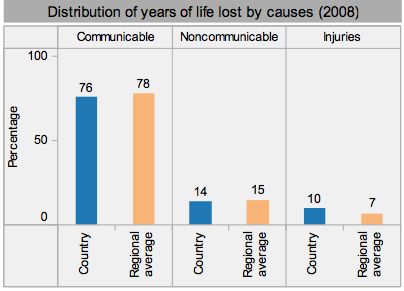
The following chart from the World Health Organization shows the remarkable impact of communicable disease in Kenya and surrounding region in 2008.
The most prominent of those diseases is HIV/AIDS, which can debilitate victims both physically and socially, carrying a stigma that prevents independence. People without significant income or the ability to grow crops for themselves are forced to depend on aid from domestic or outside sources. Even when medications are given to treat symptoms and control the HIV virus, they aren’t effective without a nutritious diet.
The cycle of disease, poverty and famine is not exclusive to Kenya or any region of the planet. There are communities everywhere that face the same struggle. There is no single event, person or government to blame. In the same way, there is no single approach or guaranteed solution.
A more effective tactic is found in the example of the “Kutulo Farm,” a women’s cooperative that Loewenberg visited in Wagberi, Kenya. After the European Union provided money for a well, the community has flourished by utilizing a water pump, windmill, and greenhouse. The journalist reported that the children appeared to be the healthiest he had encountered in the region (Loewenberg). Providing money or tools to empower local people and prevent crises is far more effective (and frugal) than attempting to feed the starving population after disaster has struck. This is especially true in a nation like Kenya where over 2 million people face starvation on a regular basis (“Kenya Food Security”).
Another example is Kenyan NGO “Acres of Mercy.” Among other local Kenyans working to initiate local farms in rural areas, where drought and disease have debilitated much of the population. I wrote the organization last month, (May 2012) and had the pleasure of a personal response from the founder. Muteti explained that what Kenyan communities need is “long term solutions to food insecurity.” She and her organization are currently raising funds to start another farm that will provide both training and food supplies to local people, particularly those affected by poverty and disease (Muteti).
Sources:
“Food Security.” Food and Agriculture Organization of the United Nations Issue 2 (June 2006): 1-4. PDF file.
Kenya: Health Profile, from World Health Organization. May 2012; Web; 30 May 2012.
Kurian, George Thomas, ed. “Kenya: History Overview.” World Geography and Culture Online. Facts On File, Inc. Web. 12 May 2012.
Loewenberg, Samuel. “The Famine Next Time.” New York Times 26 November 2011: SR5. Web. 30 May 2012.
Muteti, Catherine. “Re: Food Security Programs in Kenya.” Message to the author. 7 May 2012.
Onylego, Michael. “Already Struggling With Food Security, Kenya Faces Another Drought.” Voice of America. 13 October 2010. Web. 12 May 2010.
 Everyday life - the blog
Leave a comment